How to Build a Social Media Marketing Funnel That Actually Converts in 2026
How to Build a Social Media Marketing Funnel That Actually Converts in 2026
Most brands treat social media as a broadcast channel—posting content and hoping something sticks. The brands that consistently convert followers into customers operate differently: they build a deliberate social media marketing funnel that systematically moves prospects from awareness through consideration to decision. In 2026, with organic reach declining and ad costs rising, having a structured funnel is no longer optional—it’s the difference between social media that drives revenue and social media that drains your budget.
This guide walks through how to build, optimize, and measure a social media funnel that converts at every stage.
Understanding the Social Media Funnel: Three Core Stages
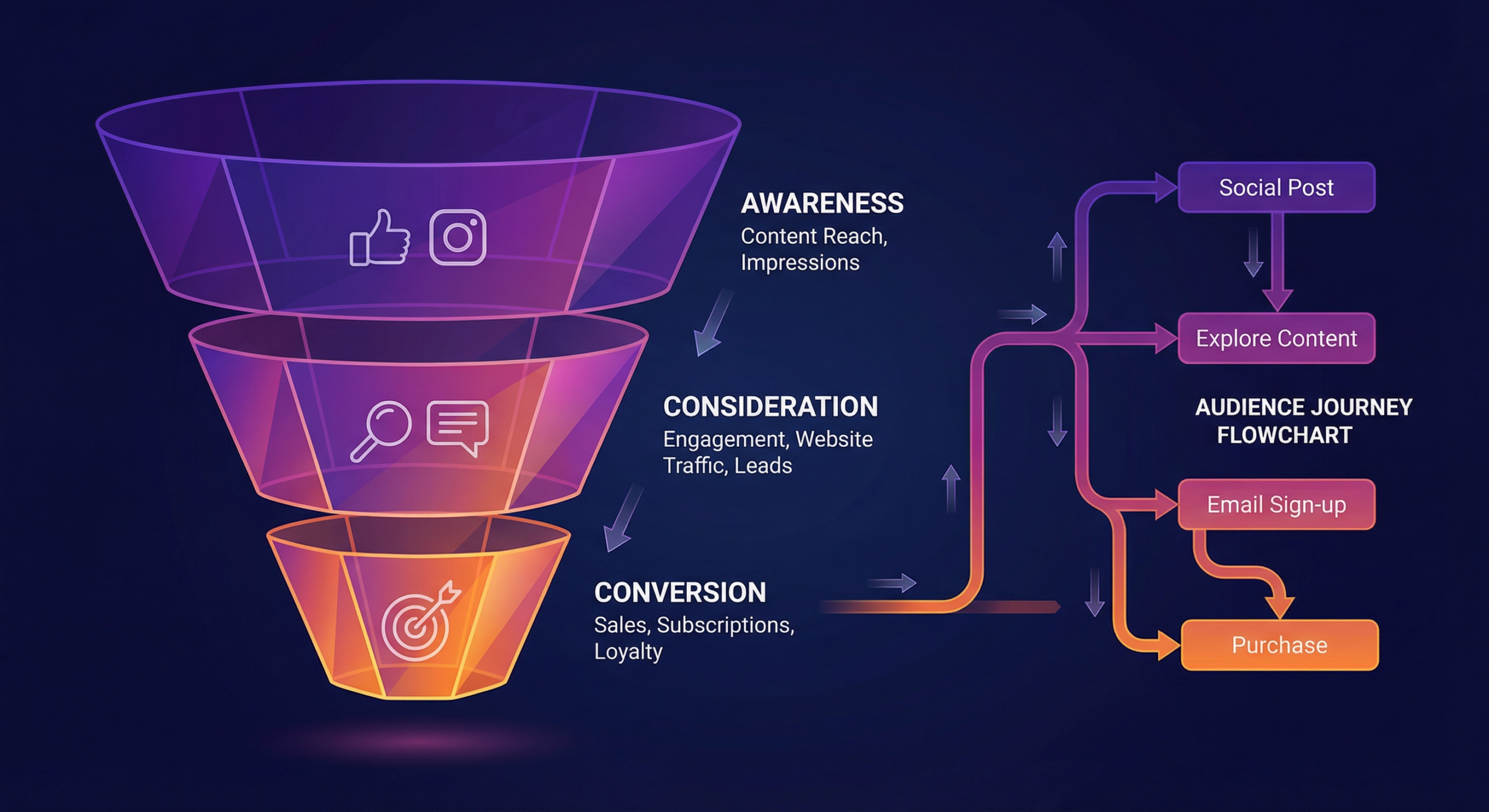
A social media marketing funnel mirrors the buyer’s journey but maps it to the specific behaviors and touchpoints that happen across social platforms:
Top of Funnel (TOFU) — Awareness: Your audience doesn’t know you exist yet, or knows your brand but has no context for why they should care. Content here is designed to reach cold audiences, stop the scroll, and create a memorable first impression. Metrics: Reach, Impressions, Video Views, Follower Growth.
Middle of Funnel (MOFU) — Consideration: Your audience knows you but hasn’t taken action. Content here builds trust, educates, and positions your brand as the best solution to a specific problem. Metrics: Engagement Rate, Saves, Link Clicks, Email Sign-Ups, Retargeted Ad CTR.
Bottom of Funnel (BOFU) — Conversion: Your audience is evaluating options and ready to buy, book, or sign up. Content here removes objections, creates urgency, and makes taking action frictionless. Metrics: Conversion Rate, Cost per Acquisition, Revenue, ROAS.
TOFU: Building Awareness Through the Right Content Mix
Top-of-funnel social content needs to do one thing exceptionally well: earn attention from people who have no reason to stop and look. This is why TOFU content is typically the most creative, entertaining, or immediately useful content in your mix.
High-performing TOFU formats include short-form video (Reels, TikTok, Shorts), trending audio or challenges, surprising data points, bold visual graphics, and relatable humor tied to your niche. The objective is not to sell—it’s to create a first positive impression that earns a follow or a save.
For paid TOFU, use broad targeting with interest and lookalike audiences. Keep ad creative raw and native to the platform (not polished production—it gets ignored). Test 4–6 creative variations per ad set and let the data surface winners within 5–7 days.
MOFU: Nurturing Through Value and Trust
Middle-of-funnel content is where most brands underinvest. They treat social media as a TOFU awareness play and then expect cold audiences to convert directly from a single ad. The MOFU layer is what makes conversion rates sustainable.
Effective MOFU content includes: detailed how-to guides (carousels, long-form video), customer testimonials and case studies, comparison content (“us vs them”), behind-the-scenes and brand story content, educational series, and email/newsletter opt-in campaigns.
For paid MOFU, retarget everyone who engaged with your TOFU content—video viewers (25%+ watched), profile visitors, Instagram Story viewers. Show them content one step deeper: social proof, benefit-focused messaging, and free value offers (guides, templates, free trials). This audience is 3–5x more likely to convert than cold traffic.
BOFU: Converting with Precision Targeting and Urgency
Bottom-of-funnel social content targets people who have already visited your website, engaged with your MOFU content, or taken an action like adding to cart. These people know your brand—they just need the right nudge.
BOFU content that converts: limited-time offers, testimonials from people similar to the prospect’s profile, risk-reducers (money-back guarantees, free trials), direct comparison vs competitors, FAQ-style objection handling, and abandoned cart reminders.
On Meta, Custom Audiences (website visitors, email lists) and your CRM contact uploads are your BOFU targeting foundation. On LinkedIn, account-based retargeting hits decision-makers who’ve engaged with your brand. On TikTok, the Pixel-based retargeting audience has matured significantly and should not be overlooked for e-commerce BOFU.
Social Media Funnel Performance Benchmarks by Stage
| Funnel Stage | Content Type | Key Metric | Industry Benchmark | Optimization Focus |
|---|---|---|---|---|
| TOFU (Awareness) | Short video, trending posts | CPM | $5–15 (Meta), $3–8 (TikTok) | Hook quality, thumb-stop rate |
| TOFU (Awareness) | Organic feed posts | Reach rate | 5–15% of followers | Posting time, format testing |
| MOFU (Consideration) | Carousel, video, email opt-in | Engagement rate | 2–5% (organic) | Value depth, CTA clarity |
| MOFU (Paid Retarget) | Testimonial ads, guides | CTR | 1.5–4% | Social proof strength |
| BOFU (Conversion) | Offer, retargeting ads | Conversion rate | 2–8% (e-com), 5–15% (lead gen) | Offer, landing page match |
| BOFU (Conversion) | Custom audience ads | ROAS | 3x–6x (e-commerce) | Audience freshness, exclusions |
FAQ: Social Media Marketing Funnel
How do I know if my social media funnel is working?
Look at conversion flow, not just top-line metrics. A working funnel shows: TOFU content generating consistent new audience growth, MOFU content producing above-average saves, click-throughs, and email sign-ups, and BOFU content converting at a rate above your pre-funnel baseline. If you’re getting tons of impressions but zero conversions, you have a MOFU gap. If you have high engagement but low conversions, your BOFU offer or landing page needs work.
What’s the biggest mistake brands make with social media funnels?
Trying to convert cold audiences immediately. Sending someone from a first TikTok impression directly to a purchase page almost never works for products above $50. The funnel exists because trust takes multiple touchpoints to build. Research consistently shows it takes 7–12 brand interactions before a cold prospect makes a purchase decision—most brands give up after 2–3 paid ad impressions and conclude “social doesn’t work.”
How much budget should I allocate to each funnel stage?
A common starting framework is 60% TOFU / 20% MOFU / 20% BOFU for brands building awareness. As your retargeting audiences grow, shift toward 40% TOFU / 30% MOFU / 30% BOFU. BOFU budget has the highest ROAS but is limited by the size of your retargeting pool—you can’t put $10K/day into BOFU if your warm audience is only 5,000 people. Grow the top to feed the bottom.
Can organic content alone power a full social media funnel?
Yes, especially for smaller budgets, though it’s slower. An organic funnel works by: consistently posting TOFU content (entertaining/educational) to attract new followers, creating MOFU content (detailed guides, testimonials) to build trust with existing followers, and using link-in-bio landing pages, DMs, and Story CTAs for BOFU conversion. Many 6-figure online businesses run entirely on organic social funnels—it just requires a more patient, consistent, content-heavy approach.
How do I track the full funnel if social platforms don’t show complete attribution?
Use a multi-touch attribution model with UTM parameters, GA4, and a CRM. UTM-tag every social link (organic and paid) so you can see which content drives traffic and converts in GA4. Layer in self-reported attribution by asking customers “how did you hear about us?” at checkout. No attribution model is perfect, but combining platform data + GA4 + CRM + self-report gives you an 80%+ accurate picture of what’s actually driving revenue.