Programmatic Advertising Guide for Marketers in 2026: How It Works and When to Use It
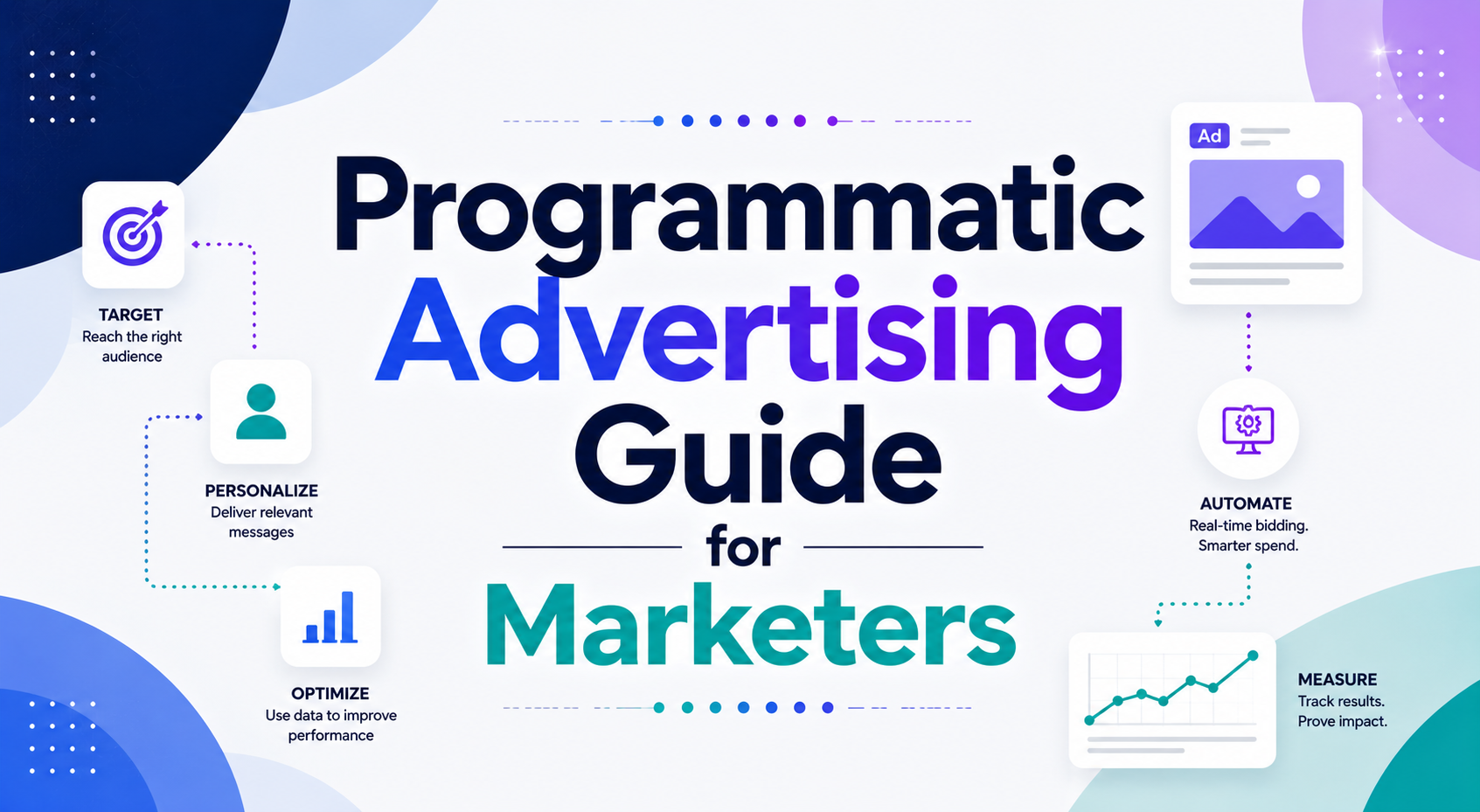
Programmatic advertising has become the dominant method for buying digital ad inventory worldwide, accounting for over 85% of all digital display ad spending in 2026. Yet many marketers still have only a surface-level understanding of how the ecosystem actually works, which platforms to use for different goals, and when programmatic outperforms (or underperforms) compared to direct buys and walled garden platforms like Google and Meta. This guide breaks down the mechanics, the players, and the practical decision-making framework for incorporating programmatic into your digital marketing strategy.
How Programmatic Advertising Actually Works
Programmatic advertising uses automated technology to buy and sell digital ad inventory in real time. When a user loads a webpage that contains an ad slot, an auction happens in approximately 100 milliseconds — advertisers bid for that impression based on the user’s profile data, the context of the page, and their campaign targeting parameters. The highest bidder’s ad is displayed.
The Programmatic Ecosystem: Key Players
Understanding programmatic requires understanding the supply chain. Publishers make inventory available through Supply-Side Platforms (SSPs). Advertisers buy through Demand-Side Platforms (DSPs). Data Management Platforms (DMPs) or Customer Data Platforms (CDPs) provide the audience data used for targeting. Ad exchanges sit in the middle, matching supply and demand in real-time auctions.
Real-Time Bidding (RTB) vs. Private Marketplaces (PMPs)
Open exchange RTB gives access to the broadest inventory at the lowest CPMs but with less control over where ads appear. Private Marketplaces (PMPs) are invitation-only auctions where premium publishers offer their inventory to selected advertisers at negotiated floor prices. PMPs provide better brand safety, more transparent inventory, and often better performance despite higher CPMs.
Programmatic Targeting Capabilities
The power of programmatic is its targeting precision. Unlike traditional media buying, programmatic allows you to reach specific audience segments across any participating publisher rather than just buying demographics from a single publication.
First-Party Data Targeting
In 2026, with third-party cookie deprecation now complete in major browsers, first-party data has become the most valuable targeting asset. Uploading your CRM data to a DSP allows you to target existing customers, lookalike audiences, and suppression lists across the open web — without depending on third-party cookies.
Contextual Targeting
Contextual targeting matches ads to page content rather than user identity, using natural language processing to categorize page content and serve relevant ads. With identity-based targeting more constrained in 2026, contextual targeting has seen a significant renaissance and consistently delivers strong performance for many categories.
Major Programmatic Platforms Compared
| Platform | Best For | Minimum Spend | Inventory Quality | Key Strength |
|---|---|---|---|---|
| The Trade Desk | Mid-large advertisers | $10,000+/mo | Very High | Data partnerships, CTV reach |
| Google DV360 | Google ecosystem users | $1,000+/mo | High | Integration with Google Ads data |
| Amazon DSP | E-commerce brands | $35,000+/mo | High | Amazon purchase intent data |
| Basis DSP | Agencies, SMBs | $500+/mo | Medium-High | Accessible entry point |
| StackAdapt | B2B, performance | $1,000+/mo | High | Native ad formats, B2B data |
When Programmatic Beats Other Digital Channels
Programmatic is not always the right choice. Understanding its comparative advantages helps allocate budget efficiently across the full digital media mix.
Programmatic Excels For
Brand awareness campaigns reaching broad or specific audience segments across multiple publishers, retargeting campaigns across the open web, connected TV (CTV) advertising, and prospecting campaigns using first-party lookalike audiences. Programmatic also excels for campaigns requiring precise frequency management across diverse inventory.
Where Walled Gardens (Google/Meta) Still Win
For direct response campaigns with tight cost-per-acquisition goals, Meta and Google’s performance advertising products often outperform programmatic for most advertisers because of their proprietary intent signals (search behavior, social engagement) and machine learning optimization infrastructure. Programmatic fills the upper and mid-funnel better than the lower funnel for most categories.
Brand Safety and Viewability in Programmatic
The open exchange has historically had brand safety challenges — ads appearing next to objectionable content, serving to bot traffic, or appearing in non-viewable placements. In 2026, these problems have significantly improved but have not been eliminated.
Verification Tools
Integral Ad Science (IAS) and DoubleVerify are the industry-standard verification tools that measure viewability, brand safety, and invalid traffic for programmatic campaigns. Most professional DSPs integrate these tools natively. Requiring 70%+ viewability and running brand safety filters as a baseline eliminates the majority of quality issues.
Frequently Asked Questions
What is the minimum budget to start programmatic advertising?
Platform minimums vary significantly. Basis DSP and StackAdapt allow starting at $1,000-$5,000 per month, making them accessible for smaller advertisers. The Trade Desk and Amazon DSP require $10,000-$35,000 monthly minimums and are primarily suited to enterprise advertisers.
Is programmatic advertising good for small businesses?
For small businesses, programmatic requires careful consideration. The platform minimums, technical complexity, and optimization time investment often make Google Ads and Meta Ads a better starting point. Programmatic becomes competitive for small businesses with budgets above $5,000/month who need reach beyond Google and Meta’s ecosystems.
How does programmatic handle privacy compliance in 2026?
Major DSPs now support privacy-compliant targeting through first-party data clean rooms, contextual targeting, and privacy-preserving identity solutions. Advertisers operating in regulated markets should verify that their DSP of choice is compliant with GDPR, CCPA, and other applicable regulations before launching campaigns.
What is a good click-through rate for programmatic display ads?
Average CTR for programmatic display is 0.05-0.1%. Programmatic display is primarily a brand awareness and reach medium rather than a direct click driver — evaluating it on CTR alone understates its value. View-through conversions, brand lift studies, and incrementality testing provide more meaningful performance measurement.
Conclusion
Programmatic advertising in 2026 is an essential tool for digital marketers with budgets above $5,000 per month who need scalable reach beyond the walled gardens. The key to success is investing in first-party data infrastructure, choosing the right DSP for your category and budget, running brand safety and viewability filters as a baseline, and measuring performance through the appropriate metrics for your campaign objective. Programmatic’s complexity rewards expertise — working with a specialist or agency often delivers significantly better results than self-managed campaigns for advertisers new to the ecosystem.