Digital Marketing Strategy in 2025: The Complete Framework

Digital marketing in 2025 is simultaneously more powerful and more complex than ever. Artificial intelligence has transformed content creation, audience targeting, and campaign optimization. Privacy changes have upended tracking and attribution. New platforms emerge while established ones shift their algorithms. To succeed in this environment, marketers need a clear framework for digital marketing strategy — one that can adapt quickly while maintaining a coherent long-term direction.
The Four Pillars of Modern Digital Marketing Strategy
Regardless of which specific channels you use, effective digital marketing strategy rests on four pillars that remain constant even as tactics evolve.
Audience Understanding
Every effective digital marketing strategy begins with deep audience understanding — not just demographics, but psychographics, pain points, decision-making processes, content consumption habits, and platform preferences. Modern audience research combines first-party data (from your own customers), social listening, competitor analysis, and direct customer interviews. The richer your audience understanding, the more precisely you can target, message, and convert.
Content as the Engine
Content remains the currency of digital marketing. Whether it’s blog posts, videos, social media content, email newsletters, podcasts, or interactive tools, content is what creates value for audiences, earns trust, and drives every stage of the customer journey. A strong content strategy defines what you’ll create, for whom, on which channels, and with what frequency.
Channel Strategy
Not every channel is right for every business. Channel strategy involves selecting the platforms and tactics where your target audience is most receptive and where your budget delivers the best return. The common mistake is spreading resources too thin across too many channels. Most successful digital marketing strategies go deep on 2-3 channels before expanding.
Measurement and Optimization
Digital marketing’s core advantage over traditional marketing is measurability. Setting clear KPIs, measuring performance against them consistently, and using data to optimize campaigns and content is what separates efficient digital marketers from those who spend without learning.
SEO in the AI Era
Search engine optimization remains foundational to digital marketing, but AI has significantly disrupted the landscape. Google’s AI Overviews now provide direct answers to many queries, reducing click-through rates for informational content. The strategic response is creating content that is either deeper than AI can provide (genuine expertise, original research, firsthand experience) or more conversational (tuned to the specific questions real people ask).
E-E-A-T: The New SEO Standard
Google’s ranking criteria now heavily weight Experience, Expertise, Authoritativeness, and Trustworthiness. Content written by demonstrable experts with real credentials, updated regularly, and backed by original experience consistently outranks thin, generically produced content. Investing in high-quality, expert-authored content is a stronger long-term SEO strategy than trying to game algorithmic shortcuts.
Paid Digital Advertising: Getting Smarter
Digital advertising has become increasingly automated and AI-driven. Google’s Performance Max, Meta’s Advantage+ campaigns, and similar AI-driven ad products are delivering better results for many advertisers — but they require a different approach to management and optimization.
First-Party Data: The New Targeting Foundation
With third-party cookies deprecated and signal loss from iOS privacy changes, first-party data — email lists, CRM data, on-site behavior — has become the foundation of effective digital advertising targeting. Building your email list is now directly linked to your advertising effectiveness. Brands with rich first-party data have a significant competitive advantage in targeted advertising.
Digital Marketing Channel Comparison 2025
| Channel | Best For | Avg. ROI | Time to Results | Budget Sensitivity |
|---|---|---|---|---|
| SEO/Content | Long-term organic traffic | High (long-term) | 6-12 months | Low (time-intensive) |
| Email Marketing | Retention, conversion | Very High ($42:1) | Immediate | Very Low |
| Google Ads | High-intent buyers | High | Days-weeks | High |
| Meta Ads | Brand awareness, prospecting | Medium-High | Weeks | High |
| Social Media (organic) | Brand building, community | Variable | Months | Low |
| Influencer Marketing | Awareness, trust-building | Medium | Weeks-months | Medium |
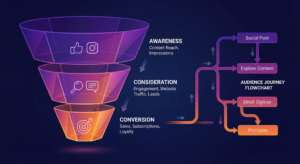
Building a Digital Marketing Funnel
Effective digital marketing moves prospects through a funnel from awareness to conversion to loyalty. Each stage requires different content, channels, and messaging.
Top of Funnel (Awareness)
At the awareness stage, your goal is reaching potential customers who don’t know you yet. Channels: SEO content, social media, YouTube, podcast sponsorships, display advertising, influencer partnerships. Metrics: reach, impressions, new website visitors, video views.
Middle of Funnel (Consideration)
At the consideration stage, prospects are aware of their problem and evaluating solutions. Channels: email nurturing, retargeting ads, webinars, comparison content, case studies. Metrics: email open rates, time on site, content downloads, webinar attendance.
Bottom of Funnel (Conversion)
At the conversion stage, prospects are ready to buy and need a final push. Channels: Google search ads, retargeting, email sequences, free trials, demos. Metrics: conversion rate, cost per acquisition, revenue.
Frequently Asked Questions
What’s the most important digital marketing channel for a new business?
For most new businesses, the answer is email marketing combined with one acquisition channel (SEO for long-term, Google Ads for immediate results, or social media for brand-forward businesses). Building your email list early creates an asset you own that isn’t dependent on any platform’s algorithm or advertising costs.
How much should I spend on digital marketing?
Industry benchmarks suggest 7-15% of revenue for established businesses and potentially 20-30% for growth-stage businesses. More important than the percentage is efficient allocation: focus spending where you have evidence of positive ROI and cut spending where you can’t demonstrate returns.
How do I measure digital marketing ROI?
Start with clear revenue attribution: track which channels and campaigns drive leads and sales. For direct channels (Google Ads, email), attribution is relatively straightforward. For brand-building channels (social media, content), use incrementality testing — measuring business outcomes with and without the channel investment.
How has AI changed digital marketing?
AI has transformed content production (faster creation, personalization at scale), advertising (automated bidding and creative testing), customer service (chatbots, personalized responses), and analytics (predictive modeling, anomaly detection). Marketers who understand how to direct and quality-check AI tools are significantly more productive than those who either ignore AI or use it without critical oversight.
Conclusion
Digital marketing strategy in 2025 requires both strategic clarity and tactical adaptability. The fundamentals — audience understanding, valuable content, channel focus, and data-driven optimization — remain constant. The tactics — which channels, which formats, which AI tools to leverage — require continuous learning and experimentation. Build your strategy on solid fundamentals, stay curious about emerging tactics, and always return to the question that matters most: where does your target customer spend time, and how can you provide value there?