Marketing Attribution Models Explained: First-Touch, Last-Touch, and Multi-Touch
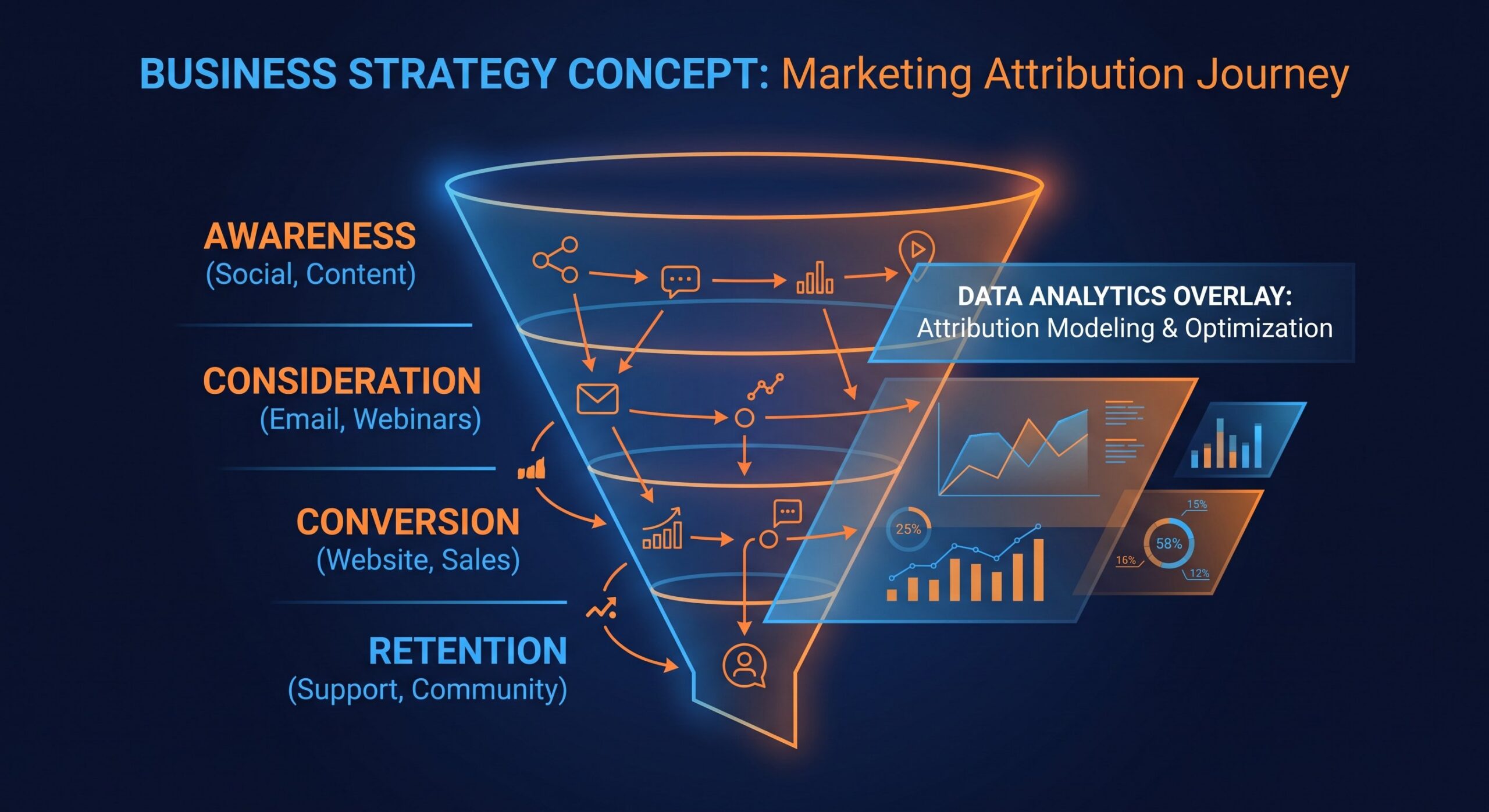
One of the most persistent challenges in digital marketing is understanding which of your marketing activities actually drives conversions. A customer might discover your brand through a social media ad, click an email two weeks later, Google your brand name, and finally convert through a retargeting ad. Which channel deserves credit for the sale? The answer depends on your attribution model—and choosing the wrong one can lead to catastrophically misallocated budgets. This guide demystifies marketing attribution so you can make smarter decisions about where your marketing dollars go.
What Is Marketing Attribution?
Marketing attribution is the process of assigning credit for conversions (purchases, leads, sign-ups) to the marketing touchpoints that contributed to them. It answers the question: which channels, campaigns, and content are actually driving results?
Why Attribution Matters
Without attribution, you’re making budget decisions based on incomplete information. Imagine you run campaigns across paid search, paid social, email, and organic social. All four channels have visitors who eventually convert. Without attribution, you don’t know which channels deserve investment and which are taking credit for conversions driven by others.
The Attribution Problem in Multi-Channel Marketing
Modern customer journeys are complex and non-linear. Research from Google shows the average customer has over 20 touchpoints before a major purchase decision. Each of those touchpoints potentially influenced the final decision. Simple single-touch attribution models (which most businesses still use) ignore this complexity and systematically over-reward or under-reward specific channels.
Single-Touch Attribution Models
Single-touch models assign 100% of conversion credit to one touchpoint—either the first or last interaction.
First-Touch Attribution
First-touch attribution gives 100% credit to the first marketing touchpoint a customer had with your brand—the first ad they clicked, the first blog post they read, the first social post they engaged with. This model is useful for understanding which channels are best at generating awareness and initiating customer journeys.
Best for: Top-of-funnel analysis; understanding awareness channels
Limitation: Ignores all nurturing and conversion-stage activities; overvalues awareness channels
Last-Touch Attribution
Last-touch (also called last-click) attribution gives 100% credit to the final touchpoint before conversion. This is the default model in Google Analytics and many CRM platforms, which explains why it’s also the most widely misused model in digital marketing.
Best for: Understanding which channels close deals; direct response campaigns
Limitation: Ignores all awareness and nurturing activities; overvalues bottom-of-funnel channels (brand search, retargeting)
Multi-Touch Attribution Models
Multi-touch models distribute conversion credit across multiple touchpoints, providing a more complete picture of the customer journey.
Linear Attribution
Linear attribution divides credit equally across all touchpoints in the customer journey. If a customer had 4 interactions before converting, each gets 25% credit. This model acknowledges that all touchpoints matter but oversimplifies by treating all equally.
Time-Decay Attribution
Time-decay attribution assigns more credit to touchpoints closer in time to the conversion. The touchpoint on the day of conversion gets the most credit; interactions from weeks earlier get less. This model reflects the intuition that recent interactions are most causally related to the purchase decision.
Best for: Short sales cycles; direct response campaigns
Position-Based (U-Shaped) Attribution
Position-based attribution gives disproportionate credit to the first and last touchpoints (typically 40% each) with the remaining 20% distributed among middle touchpoints. This model values both brand discovery and conversion—a reasonable assumption for many businesses.
Best for: Businesses that want to honor both awareness and conversion channels
Data-Driven Attribution
Data-driven attribution uses machine learning to assign credit based on the actual impact of each touchpoint on conversion probability—not a predetermined formula. It compares converting and non-converting paths to identify which touchpoints meaningfully changed conversion likelihood.
Best for: High-volume businesses with enough conversion data for statistical validity
Requirement: Typically needs 500+ monthly conversions for reliable results
Attribution Model Comparison
| Model | Credit Distribution | Best Use Case | Data Required | Complexity |
|---|---|---|---|---|
| First-Touch | 100% to first touchpoint | Awareness analysis | Low | Simple |
| Last-Touch | 100% to last touchpoint | Direct response | Low | Simple |
| Linear | Equal across all touchpoints | Full-funnel overview | Medium | Medium |
| Time-Decay | More to recent touchpoints | Short sales cycles | Medium | Medium |
| Position-Based | 40/20/40 first-middle-last | Balanced view | Medium | Medium |
| Data-Driven | ML-assigned by impact | High-volume businesses | High (500+ conv/mo) | Complex |
How to Choose the Right Attribution Model
There’s no universally correct attribution model—the right choice depends on your business model, sales cycle length, and what decisions you’re trying to make.
For Top-of-Funnel Budget Decisions
If you’re trying to decide whether to invest more in brand awareness channels (content, social, PR), use first-touch or position-based attribution. Last-touch will systematically under-credit these channels and lead you to cut spending that’s actually generating future conversions.
For Short Sales Cycles (Under 24 Hours)
For e-commerce or impulse purchases with very short decision windows, last-touch or time-decay attribution is often the most accurate. The customer’s journey from first awareness to purchase is compressed enough that the last interaction is highly causally significant.
For Long Sales Cycles (B2B, High-Value Purchases)
Long sales cycles with many touchpoints over weeks or months require multi-touch models. Position-based or data-driven attribution provides the most actionable insights for complex B2B buyer journeys.
Cross-Channel and Cross-Device Attribution Challenges
Even with the right model, attribution has fundamental limitations that every marketer should understand.
The Cross-Device Problem
A customer might first discover your brand on their phone, research on their laptop, and purchase on their tablet. Without identity resolution across devices, these appear as three separate users in your analytics. Solutions: login-based tracking (requiring user accounts), probabilistic matching, and Google/Meta’s unified identity graphs.
Dark Social and Offline Touchpoints
Word-of-mouth recommendations, podcast mentions, and in-person interactions drive significant purchasing decisions but are nearly impossible to attribute. Marketing mix modeling (MMM) is better suited than digital attribution for capturing these influence channels.
Frequently Asked Questions
What attribution model does Google Analytics 4 use by default?
GA4 uses data-driven attribution as its default model for conversion reporting (for properties with enough data). It also offers last-click, first-click, linear, position-based, and time-decay models for comparison.
Can I use multiple attribution models at the same time?
Yes, and you should. Use different models for different decisions: first-touch to evaluate awareness investments, last-touch to optimize conversion campaigns, and data-driven for overall budget allocation. Most analytics platforms allow model comparison views.
How is marketing attribution different from marketing mix modeling?
Attribution is path-based: it tracks individual customer journeys and assigns credit to specific touchpoints. Marketing mix modeling (MMM) is statistical: it analyzes aggregate sales data to understand the impact of marketing channels, including offline ones that attribution can’t capture. They’re complementary approaches.
What tools are best for marketing attribution?
Platform-native tools (Google Analytics 4, Meta Ads Manager) provide baseline attribution. Dedicated tools like Northbeam, Triple Whale, and Rockerbox offer cross-platform attribution with better accuracy for e-commerce. Enterprise options include Nielsen Attribution and Analytic Partners.
How do I present attribution data to non-marketing stakeholders?
Focus on business impact, not channel metrics. Instead of showing which model each channel performs best under, show how budget allocation based on your chosen model compares to business outcomes. Storytelling with customer journey examples makes attribution tangible for non-technical audiences.
Conclusion
Marketing attribution is never perfect—every model is an approximation of a messy, multi-channel reality. But choosing an informed model that matches your business and making consistent decisions based on it is vastly better than relying on last-click defaults or ignoring attribution entirely. Start with a model that fits your sales cycle and available data, compare multiple models for important budget decisions, and move toward data-driven attribution as your conversion volume grows. The brands that understand attribution make smarter budget decisions—and that advantage compounds over time.